
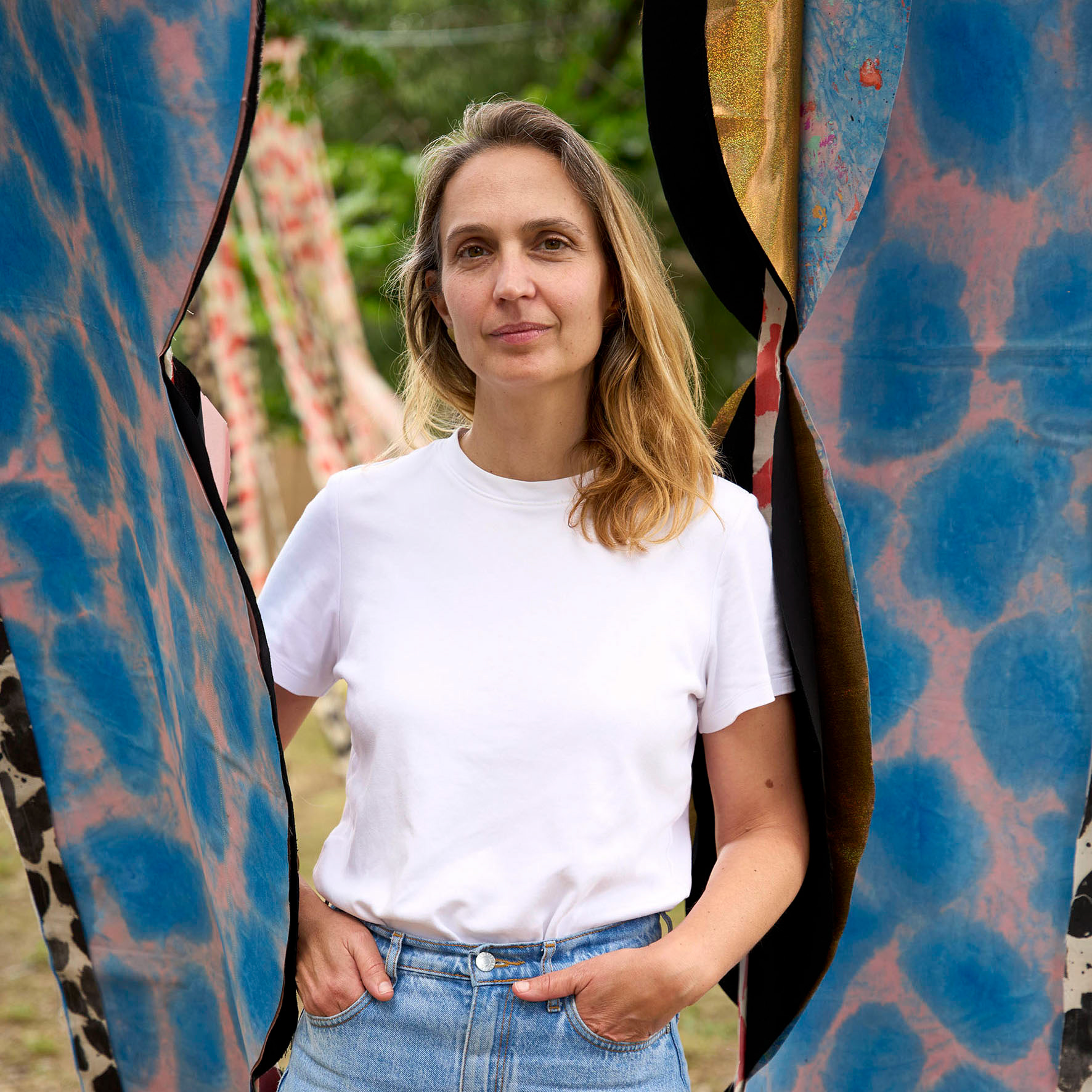
photo : Thomas Heydon

Par Laëtitia Toulout, critique d'art
Pour l'artiste Clémentine Chambon, qui débute sa carrière dans le design, l'objet est le lieu de création et de liberté qui lui permet de transmettre et de raconter, de partager son regard sur le monde, avec joie et légèreté apparentes. Cette recherche perpétuelle de sens, de récit, fait brouiller les lignes du design, qui se situe ici à l'interaction entre fonction, décoration et recherche. L'artiste et designer met un point d'honneur à créer du beau, dans une volonté de faire du bien, d'apporter comme un baume au cœur, dans un geste à la fois radieux et généreux. Des oiseaux flamboyants se prêtent aux vents, illuminent le ciel de leur patchwork de couleurs puis se disséminent en multiples bribes. Conçus lors d'ateliers participatifs, ces cerfs-volants de tissu, destinés à flotter dans les rues de Nîmes, se déchirent face aux intempéries ; pour Clémentine Chambon, ces oiseaux sont à la fois issus de l'amour né du collectif, de la création mutuelle, mais également de la colère, dont ils portent les traits sur leurs visages. L'histoire de ces « Angry birds » aurait pu s'arrêter là, aux tissus fragilisés et abîmés par des vents trop violents, mais l'artiste choisit de leur offrir une seconde vie : elle récupère les étoffes peintes, découpées et cousues, les répare et les abrite dans un refuge, un mazet niché dans les vignes, « La chambre des oiseaux » (Les Costières de l'art, 2025). En restaurant non seulement la forme matérielle mais également les souvenirs et les émotions, l'artiste propose un acte de régénération, de mémoire réparatrice ; le soin est tout autant matériel que psychologique. Cette œuvre des oiseaux et les multiples rebondissements qui la suivent et la construisent sont représentatifs de la démarche de Clémentine Chambon, qui crée à partir d'histoires, depuis les phases de réflexion et de conception des pièces jusqu'à leur transmission et réception dans le monde. Les spécificités des matériaux peuvent devenir point de départ pour la figuration des œuvres, comme avec Fauteuil Elliptic, pièce dans laquelle les propriétés naturelles du rotin orientent la forme de l'objet, une ligne qui s'ondule. Elle met en exergue la petite ou la grande histoire, par exemple avec les lampes Doll, réalisées à partir de dentelle Solstiss et qui prennent la forme de personnages du 19e siècle vêtus de capes et cols retournés. Ici, la forme fait référence de manière presque cinématographique à l'histoire du textile, à travers un jeu entre l'objet et sa confection, tel un clin d'œil appuyé.
« Réparer consiste moins à effacer la trace qu'à composer avec elle. »
Le design de Clémentine Chambon fait sourire et rêver, chaque pièce étant comme une porte qui s'ouvre vers des imaginaires. C'est le cas avec Alice Stool, qui est à la fois un tabouret et une ouverture dans le conte d'Alice au pays des merveilles ; le meuble se théâtralise. C'est le cas aussi avec Shelter (2022-2023), une installation réalisée sur la plage, à partir de bois flotté récupéré suite à une tempête, et transformée en refuge qui permet de se retrouver et de contempler le paysage. Là encore, réparer consiste moins à effacer la trace qu'à composer avec elle. Clémentine Chambon crée des objets qui tissent des récits, dans leurs formes, mais aussi via leurs ornementations. Elle manie en effet les rythmes des couleurs, comme une musique visuelle qu'elle joue à travers des motifs répétés sur les objets, tapis ou tapisseries. Si elle conserve du design le fait de donner du sens à l'objet depuis ses formes, ou encore de procéder par division des étapes de fabrication, sa démarche tend de moins en moins à considérer un objet comme achevé mais au contraire, à déployer de nouvelles expérimentations, à s'ouvrir à l'aventure et au partage, à l'inconnu et à la spontanéité, assumant le bricolage et les imperfections liées à cette démarche. Créer est pour Clémentine Chambon un moyen de partager les émotions qui traversent tout un chacun ; elle ouvre de nouveaux dialogues. Depuis la perfection du design jusqu'à l'incertitude du tâtonnement, c'est tout un rapport à l'objet qu'elle déconstruit et réapprend, au quotidien et auprès des autres. Elle revendique ainsi le jeu et la rêverie, s'imprégnant tout autant des interactions et relations nées des ateliers collectifs, que des paysages — la garrigue et sa végétation clairsemée, la lumière blanche et franche de la Méditerranée où elle choisit de vivre. Perméable aux éléments et aux accidents, l'œuvre de Clémentine Chambon est comme un espace avec différentes pièces faites pour habiter, pour se rassembler et pour rêver.

ACQUISITIONS DANS DES COLLECTIONS PUBLIQUES • 2023, Mobilier National - console Cosmo, éditeur Exto • 2021, Mobilier National - lampe Doll • 2019, CNAP - fauteuil Elliptic, éditeur Bonacina, dessins et maquettes représentés par The Art Design Lab
RÉCOMPENSES ET PRIX • 2026, French Design 100 - collection de papier peint Villa, éditeur Maison Bonami • 2024, French Design 100 - Elliptic Limited Edition, éditeur Bonacina • 2021, Mondes Nouveaux - projet Shelter 2022 et 2023

By Laëtitia Toulout, art critic
For artist Clémentine Chambon, who began her career in design, the object is a space of creation and freedom, a way to convey and to tell stories, to share her view of the world with apparent joy and lightness. This constant search for meaning and narrative blurs the boundaries of design, which here sits at the intersection of function, decoration and research. The artist and designer is committed to creating beauty, with the aim of doing good, of offering something like a balm for the soul, through a gesture that is both radiant and generous. Flamboyant birds surrender to the winds, lighting up the sky with their patchwork of colours before scattering into countless fragments. Created during participatory workshops, these fabric kites, made to float through the streets of Nîmes, tear apart in the face of the weather. For Clémentine Chambon, these birds are born of the love that comes from collective, shared creation, but also of anger, whose marks they bear on their faces. The story of these "Angry Birds" could have ended there, with fabrics weakened and damaged by winds that were too strong. Instead, the artist chooses to give them a second life: she recovers the painted, cut and sewn fabrics, repairs them and shelters them in a refuge, a mazet (a small traditional stone cottage) nestled among the vineyards, La chambre des oiseaux (Les Costières de l'art, 2025). By restoring not only the material form but also the memories and emotions, the artist proposes an act of regeneration, of reparative memory; the care is as much psychological as it is material. This work, and the many twists and turns that follow and shape it, is representative of Clémentine Chambon's approach: she creates from stories, from the reflection and design phases of her pieces through to their transmission and reception in the world. The specific qualities of materials can become the starting point for a work's form, as with the Elliptic Armchair, in which the natural properties of rattan guide the shape of the object into an undulating line. She highlights stories both small and grand, for example with the Doll lamps, made from Solstiss lace and shaped like 19th-century figures dressed in capes and turned-down collars. Here, the form refers in an almost cinematic way to the history of textiles, through an interplay between the object and its making, like a knowing wink.
"To repair is less about erasing the trace than about composing with it."
Clémentine Chambon's design makes people smile and dream, each piece like a door opening onto imaginary worlds. Such is the case with Alice Stool, which is at once a stool and a gateway into Alice in Wonderland; the furniture becomes theatrical. Such is also the case with Shelter (2022–2023), an installation built on the beach from driftwood gathered after a storm and transformed into a refuge, a place to find oneself and contemplate the landscape. Here again, to repair is less about erasing the trace than about composing with it. Clémentine Chambon creates objects that weave narratives, through their forms but also through their ornamentation. She plays with rhythms of colour like a visual music, performed through patterns repeated across objects, rugs and tapestries. While she retains from design the practice of giving meaning to an object through its form, and of breaking down the stages of fabrication, her approach increasingly moves away from considering an object as finished. Instead, it unfolds into new experiments, opening up to adventure and sharing, to the unknown and to spontaneity, embracing the improvisation and imperfections that come with this approach. For Clémentine Chambon, creating is a way of sharing the emotions that run through every one of us; she opens up new dialogues. From the perfection of design to the uncertainty of trial and error, she deconstructs and relearns an entire relationship to the object, day after day and alongside others. She thus champions play and reverie, drawing as much on the interactions and relationships born of collective workshops as on the landscapes around her: the garrigue and its sparse vegetation, the stark white light of the Mediterranean where she has chosen to live. Open to the elements and to accidents, Clémentine Chambon's work is like a house with many rooms, made for dwelling, for gathering and for dreaming.